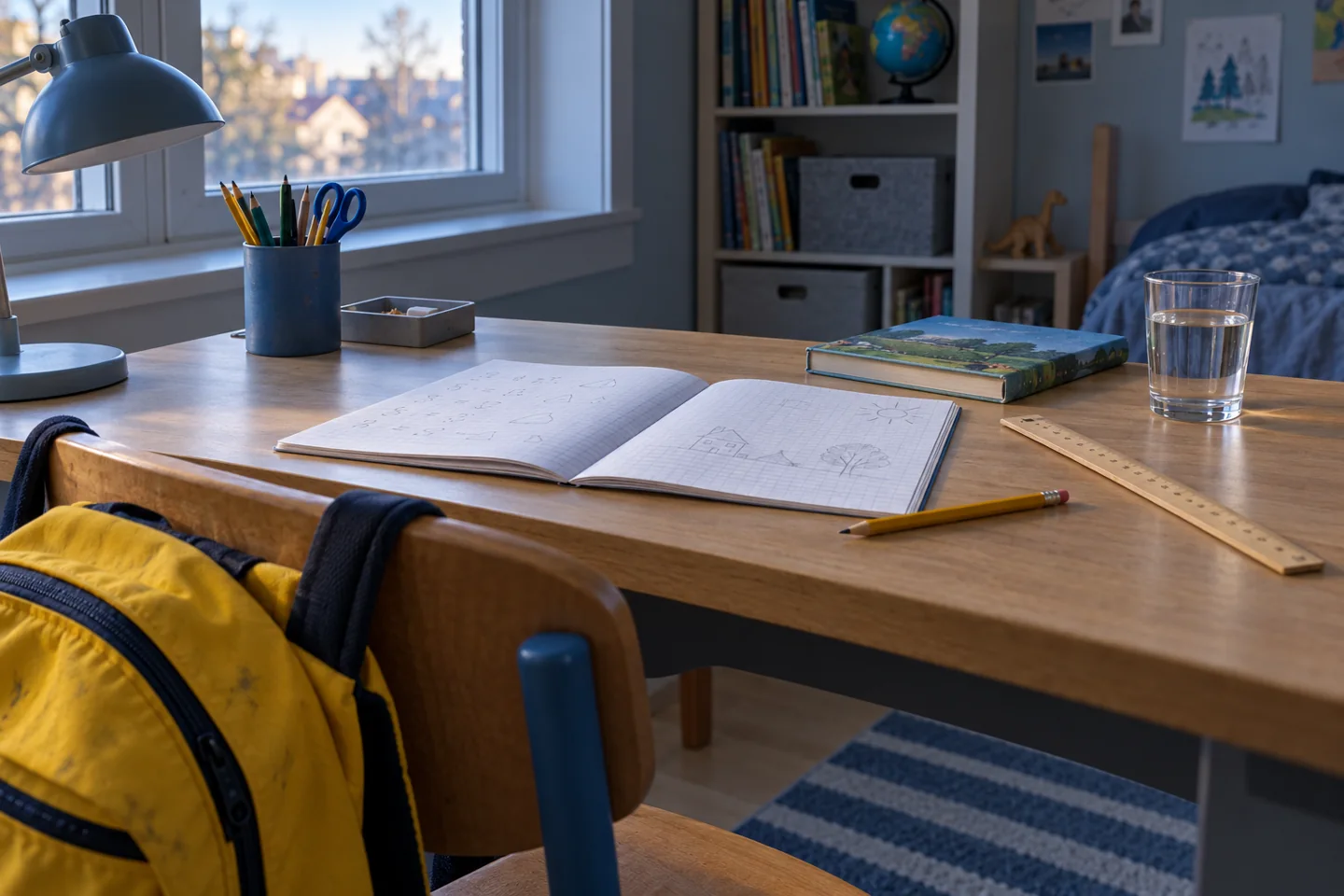
The pencil is still capped, the worksheet is still blank, and the clock has moved past the time you meant to start winding down. You may be tempted to turn the evening into a race. Before choosing between finishing everything and giving up, find out what the blank page is telling you: is the first step unclear, is your child tired, or did the assignment simply get lost in the day? You don’t need to solve the whole school week tonight.
Set a limit before you start
Name the practical boundary without making it a threat. For example, you could say, “Bedtime is still happening at the usual time. Let’s use the next fifteen minutes to see what we can do.” A five-year-old may need you to point to one line or read a direction aloud; an older child may be able to choose a section and work independently while you stay nearby. Adjust the time to your household and the child’s capacity, rather than treating a timer as a test of character.
The trade-off is real: staying up might produce a more complete sheet, but it can also make tomorrow harder. Decide whether the assignment has a clear, small piece worth attempting tonight. If it does, agree on that piece. If it doesn’t, use the available time to identify the obstacle and prepare a note for the teacher. UNICEF’s guidance for teens encourages achievable daily goals, breaks, and calm problem-solving when schoolwork feels frustrating [1].
Make the first mark easy
A blank page can be hard to enter because the child doesn’t know where to begin, expects every answer to be perfect, or has run out of energy. Ask one specific question: “Which part feels hardest to start?” If your child can’t say, offer two choices: “Would you like me to read the first direction, or would you rather pick the easiest question?” Choices should help them begin, not disguise a demand to finish everything.
Keep your help small enough that the work remains theirs. You might read a direction, clarify a word, or help find the page number, then give the pencil back. You might say, “I can help you understand the question; you’ll choose and write your answer.” For a child who needs more support, sit beside them and do one question together, then pause to see whether the next one feels manageable. Don’t fill in answers simply to make the sheet look complete.
When the first try goes nowhere
If your child stares, argues, or pushes the paper away, repeating the same prompt louder is unlikely to create more time or energy. Pause for a few minutes, offer water or a quiet reset, and then change the size of the task. You could say, “This isn’t moving yet. We can do one question together, or stop and tell the teacher what got in the way.” The second option isn’t a reward or a failure; it’s a way to end the evening without pretending the work happened.
If even one question together feels too much, stop. Keep the sheet where it can go back to school, and write a brief factual note: “We set aside time tonight, but the page remained blank. Could you help us understand the first step?” If this keeps happening, collect the worksheet and any directions so you can ask the teacher about the work itself, the amount, or how it is being explained. Repeated difficulty is useful information, not a reason to label the child or make every evening a longer battle.
References
Sources for the cited guidance and reported material. Worked examples and practical tools are original to Zolls.