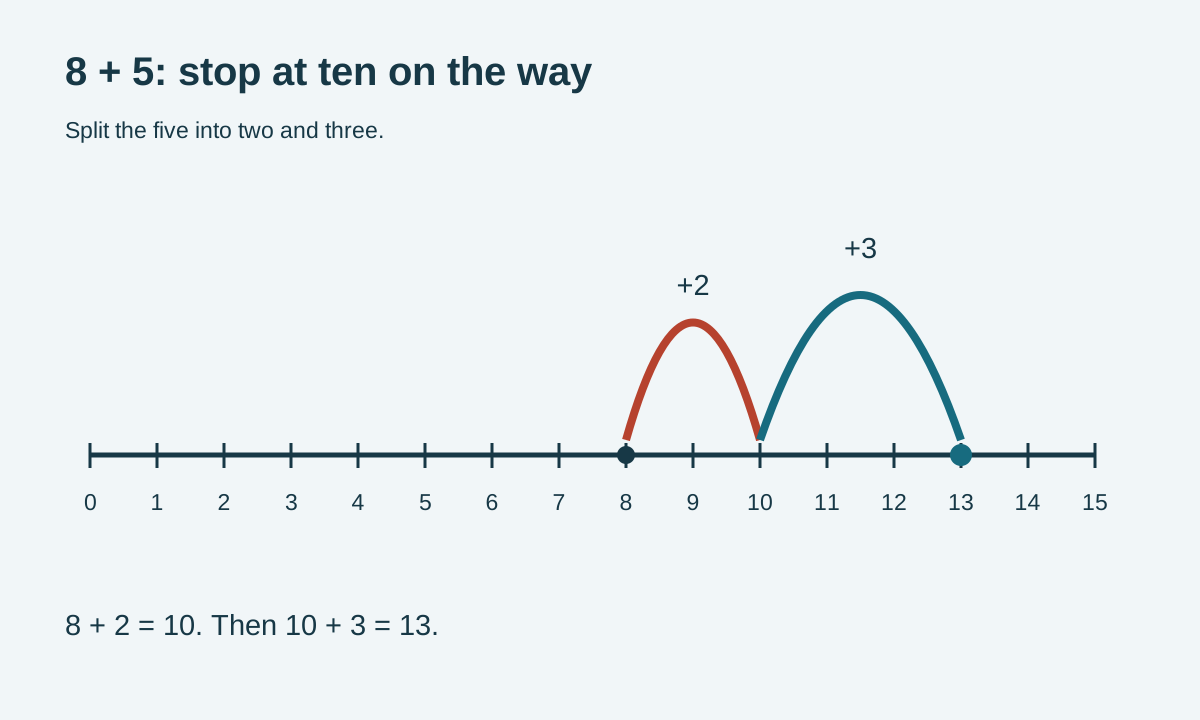
Draw a number line from 0 to 15 with every tick labeled. To model 8 + 5, begin at 8 and travel five units forward.
Keep the scale even
Space the ticks evenly and label them 0 through 15 in order. Check that each neighboring pair differs by one. A line with missing or unevenly spaced marks can make a correct jump hard to interpret.
The Institute of Education Sciences describes number lines as useful representations for learning mathematical concepts and procedures. [1] Here, the important feature is that each step represents one unit of distance.
Start at eight, not one tick later
Mark the starting point at 8. The starting point represents the first quantity; it is not the first unit of the added amount. A jump of one from 8 lands at 9, so the next tick—not the starting tick—marks the first unit traveled.
This distinction prevents a common counting error. If the learner counts the starting point as “one,” ask them to trace one actual interval and name its endpoints.
Split the five at the next ten
Ask how far 8 is from 10. It is two units. Draw a jump from 8 to 10 and label it +2. The original five units now have three still to travel, so draw a second jump from 10 to 13 and label it +3.
The jumps total five units: two plus three. Their landing point is 13, so 8 + 5 = 13. Keep the jump labels visible; the decomposition explains why the line crosses ten.
Read the drawing as distance
Trace from 8 to 10, then from 10 to 13. Count the intervals in each jump, not the labeled ticks touched along the way. The first jump covers two intervals, and the second covers three.
Ask the learner to describe both the route and the destination: “I traveled five units from eight and landed on thirteen.” This connects the total distance traveled to the addition sentence and helps distinguish a jump label from a position label.
Compare useful representations
A number line is especially clear when the question involves movement along a scale or a change in amount. Counters may make the two parts of five easier to rearrange physically. Both can show the same calculation, but each emphasizes something different.
If the drawing is crowded, simplify it before adding more marks. A short, labeled line is more useful than decorative jumps or ticks that do not have a consistent value.
Now try 9 + 4 without showing the route first. Ask how far it is from nine to ten. One step reaches ten, leaving three of the four steps still to take; three more reaches thirteen. Draw the one-step jump and the three-step jump in different colours and write 9 + 1 + 3 = 13 below. If the child counts the starting tick as a step, return to nine and move a counter once for each interval crossed. The counter starts on a number; the first move takes it to the next number. This is another worked example, not a timed test. [1]
References
Sources for the cited guidance and reported material. Worked examples and practical tools are original to Zolls.
- Institute of Education Sciences. Assisting Students Struggling with Mathematics: Intervention in the Elementary Grades.