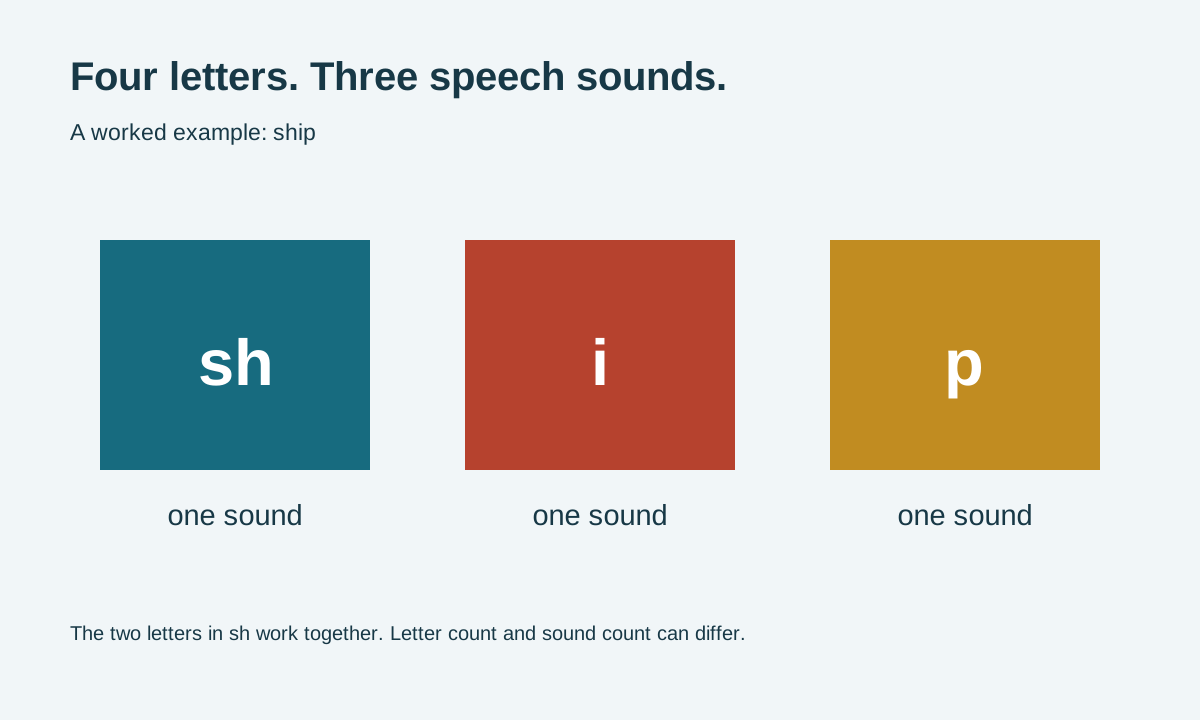
In ship, four printed letters represent three speech sounds. The two letters sh spell one sound, so a reader can map the word as /sh/ /i/ /p/.
Separate letter names from speech sounds
The letter names are ess, aitch, eye, and pee. Those names can help identify letters, but saying them in sequence does not sound out the word. To blend ship, attend to the sounds heard in the spoken word: /sh/ at the beginning, /i/ in the middle, and /p/ at the end.
A phoneme is a speech sound; a grapheme is a letter or group of letters used to represent a sound. The Institute of Education Sciences practice guide recommends teaching awareness of speech sound segments and how they connect to letters. [1]
Treat sh as one spelling unit here
The letters s and h sit next to each other, but in ship they form the digraph sh, representing one sound, /sh/. Do not split the beginning into separate /s/ and /h/ sounds. The word therefore has four letters and three phonemes.
Pointing under each letter can accidentally suggest that every letter gets its own sound. Instead, mark or sweep under sh together, then attend to i and p. The visible spelling has four characters; the spoken sound sequence has three parts.
Blend the sounds into the word
A simple worked example is: identify sh as /sh/, say /i/, then /p/, and blend /sh/ /i/ /p/ into ship. Keep the sounds connected enough that the child can hear the whole word. If the reader says the letter names or adds an extra sound between parts, model the sound sequence again without turning it into a test.
This example illustrates the spelling and sound structure of one word. It is not a claim that a particular short routine is an evaluated intervention. The IES guide supports explicit attention to sound segments and their links to letters as part of foundational reading instruction. [1]
Coordinate the language used for practice
If school is teaching a particular routine or notation, ask the teacher how the sound is represented and use that same convention at home. English spelling includes patterns that may not behave like ship, so avoid treating this one example as a rule for every word.
Keep practice brief and focused on the intended skill: notice the two-letter digraph, say its single sound, then blend with the remaining sounds. If the child is confused, return to the spoken word and model its three sounds rather than adding more letter names.
For a second short practice, change ship to shop. Keep the sh and p groups visible while you replace the vowel. Say the sounds for the new word and blend them, rather than asking the child to guess from the first letter. Then return to ship and ask what changed. These are original worked examples of sound-to-letter practice, not a claim about a particular child’s reading level. Use the pronunciation and letter-sound conventions the school is teaching. [1]
References
Sources for the cited guidance and reported material. Worked examples and practical tools are original to Zolls.
- Institute of Education Sciences. Foundational Skills to Support Students in Kindergarten Through 3rd Grade.