Retelling works best as a way to revisit a story, not as a test of memory. Invite a child to share the thread of what happened, and keep the text available when either of you needs it.
Set a small, understandable task
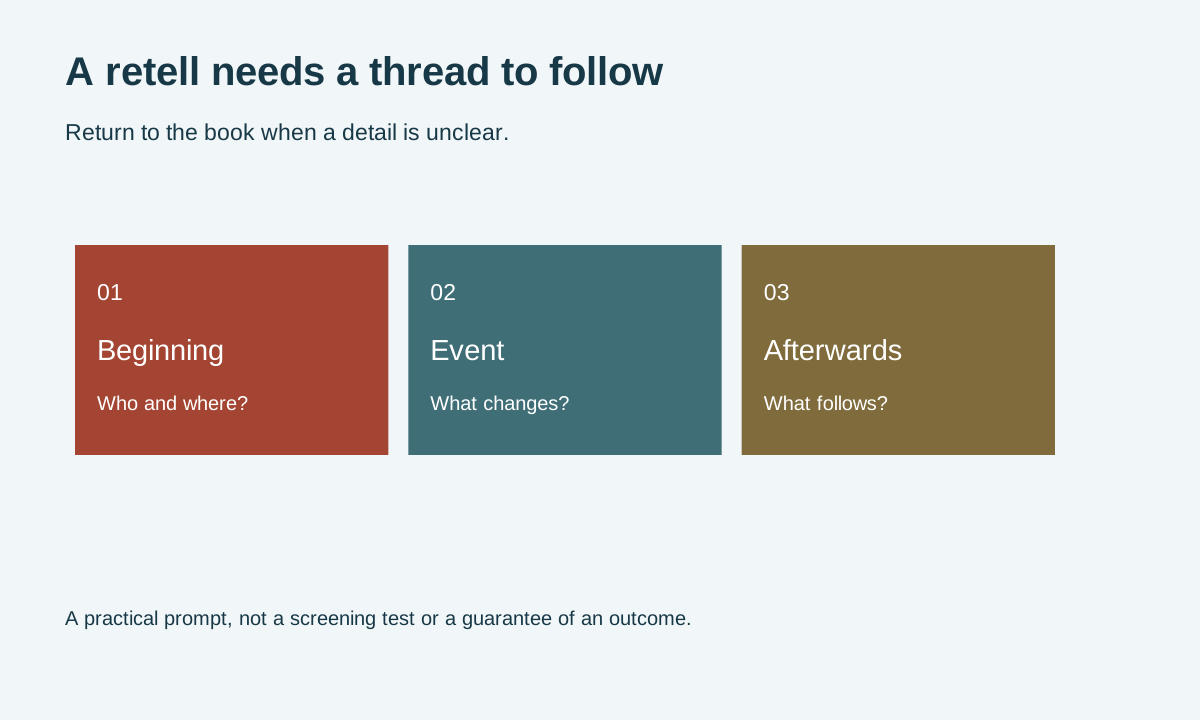
After reading a short story or passage, ask the child to tell what happened in a few parts. A useful shape is beginning, important event, and ending. Explain that a retell does not have to include every detail or use the exact words from the page.
This kind of talk gives a reader practice organizing events and expressing ideas. The Institute of Education Sciences identifies narrative language and comprehension as part of foundational reading support, alongside word reading and connected text. [1] That guidance supports making room for story talk; it does not require a fixed retell script or a score.
Begin with an open invitation
Try “Tell me what happened in this part” or “What do you remember about the story?” Then wait. A pause gives the child time to decide where to begin. Avoid firing off a sequence of questions such as who, what, where, and when; rapid prompts can make a shared conversation feel like a quiz.
If the child gives one detail, respond to that detail and leave space for more. “You remembered that the door opened. What happened after that?” is more supportive than marking the first answer as incomplete. When the child prefers, they can point to a picture or passage before putting the idea into words.
Listen for a thread, not a perfect summary
A short retell can include a beginning, one event that matters, and an ending. These are helpful anchors, not boxes the child must fill in with equal detail. Let the child use their own order at first; if the sequence becomes hard to follow, ask a gentle organizing prompt such as “What happened first?”
Notice whether one event connects to the next and whether the ending relates to what the story set up. Do not infer understanding from one missing detail, or ask for a motive or fact the passage does not supply. A reader may understand the main action without remembering every name or description.
Use the passage as a shared reference
When a detail is unclear, return to the relevant part of the text and read it again. You can say, “Let’s see what the page tells us,” then point to the sentence that helps. The purpose is to build the retell from the story, rather than to reward guessing or make the child defend an uncertain memory.
Model a short retell if the child needs a starting point: “At the beginning, the character finds a note. Then the note changes what they decide to do. At the end, they return to the place they started.” This is a generic example of a retell shape, not a claim about a particular book. Keep examples accurate to the passage you actually read.
Make room for vocabulary and connections
A child may describe a key idea without using the story’s exact vocabulary. Offer a useful word naturally and connect it to the sentence: “The character felt relieved—that means the worry had eased.” Then invite the child to continue. Avoid interrupting every sentence to correct wording; the retell’s main job is to communicate what happened.
You can also ask what part helped the child understand an event, or which word was new. Keep questions grounded in the visible text and the child’s own response. The IES guidance includes vocabulary and narrative language, so a conversation about a word or sequence can extend reading without turning into a battery of comprehension checks. [1]
Close with one clear idea
End by reflecting one part of the story the child brought out: “You showed how the note changed the plan.” If the retell wandered, help summarize the central event in one sentence, then finish. There is no need to repeat the entire exercise until every detail is present.
If retelling is routinely difficult, share examples with the teacher and ask what the child is working on in class. A home retell is a small opportunity for language and meaning-making, not a diagnostic checklist or a substitute for instruction.
References
Sources for the cited guidance and reported material. Worked examples and practical tools are original to Zolls.
- Institute of Education Sciences. Foundational Skills to Support Students in Kindergarten Through 3rd Grade.