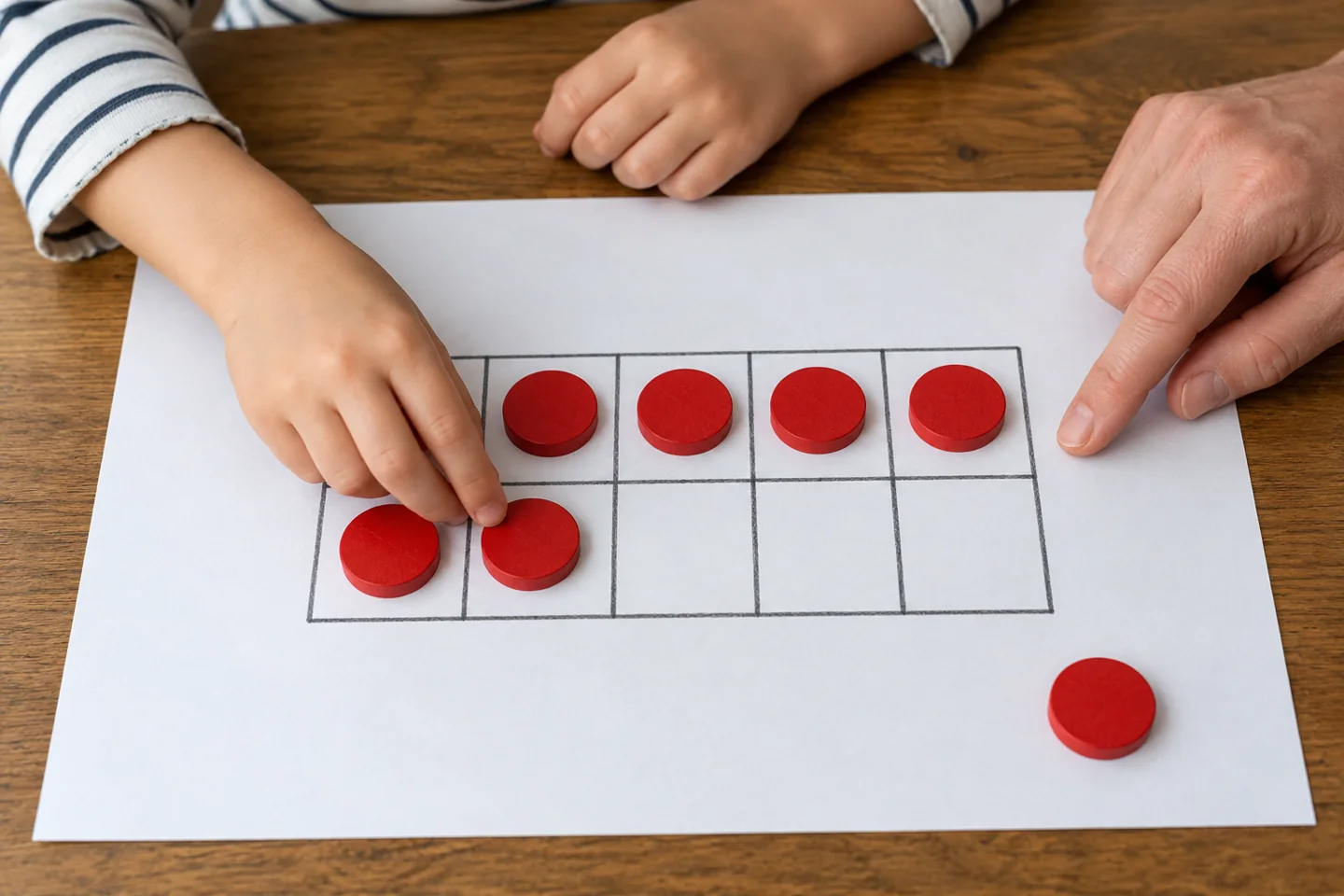
Set out seven counters in one group and five in another. The goal is to see how the same twelve objects can be rearranged to make a useful ten.
Start with quantities, not a shortcut
Use large counters, tiles, or paper squares on a clear surface. Ask the learner to make a group of seven and a separate group of five, touching each object as it is counted. Confirm that the two groups contain seven and five before changing their arrangement.
This is a representation of the quantities, not a speed exercise. The Institute of Education Sciences recommends using concrete and semi-concrete representations to support mathematical understanding, alongside clear mathematical language. [1]
Move only what completes ten
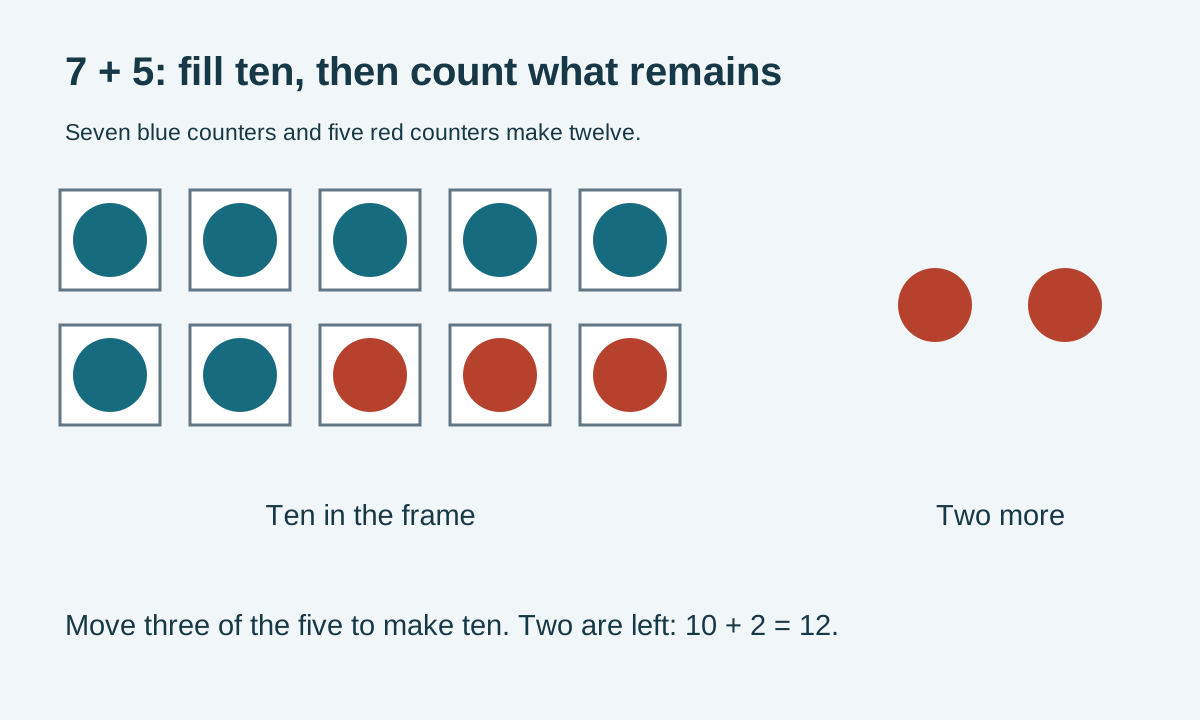
Look at the group of seven. Ask how many more counters would make ten. Move three counters from the group of five beside the seven. Count the completed group: seven, eight, nine, ten. Two counters remain from the five.
The rearrangement has not changed the total number of counters. It has changed how they are grouped: seven plus five is now ten plus two. Ask the learner to point to each group while explaining what moved and what stayed.
Connect the objects to the number sentence
Write 7 + 5 = 12. Under it, record the same calculation in two steps: 7 + 3 = 10, then 10 + 2 = 12. Draw a mark or line from the three moved counters to the 3 in the first step, and from the two remaining counters to the 2 in the second.
The plus sign still means combine the original amounts. The intermediate ten shows one way to organize that combination; it does not replace the original five. Have the learner explain why the five became three and two, and why the answer is twelve.
Let the learner choose the next representation
After the counters make sense, sketch a ten-frame or two boxes labeled 10 and 2. The learner can place three marks into the seven-frame's empty spaces, with two marks left over. Keep the drawing close to the objects so the matching quantities remain visible.
A representation should clarify the same quantities rather than add a new puzzle. If the learner loses track, return to the counters and recount the groups. School staff can help choose representations that align with what the class is using.
Readiness for a mental step
A learner may be ready to imagine the move when they can explain that three completes seven to ten, and that two remain from five. Mental calculation is not a separate trick: it compresses actions that can first be shown and described.
Invite another calculation only when the first representation is understood. Ask what amount would complete the next group to ten and how the leftover amount will be counted. Accuracy and explanation matter more here than finishing quickly.
References
Sources for the cited guidance and reported material. Worked examples and practical tools are original to Zolls.
- Institute of Education Sciences. Assisting Students Struggling with Mathematics: Intervention in the Elementary Grades.