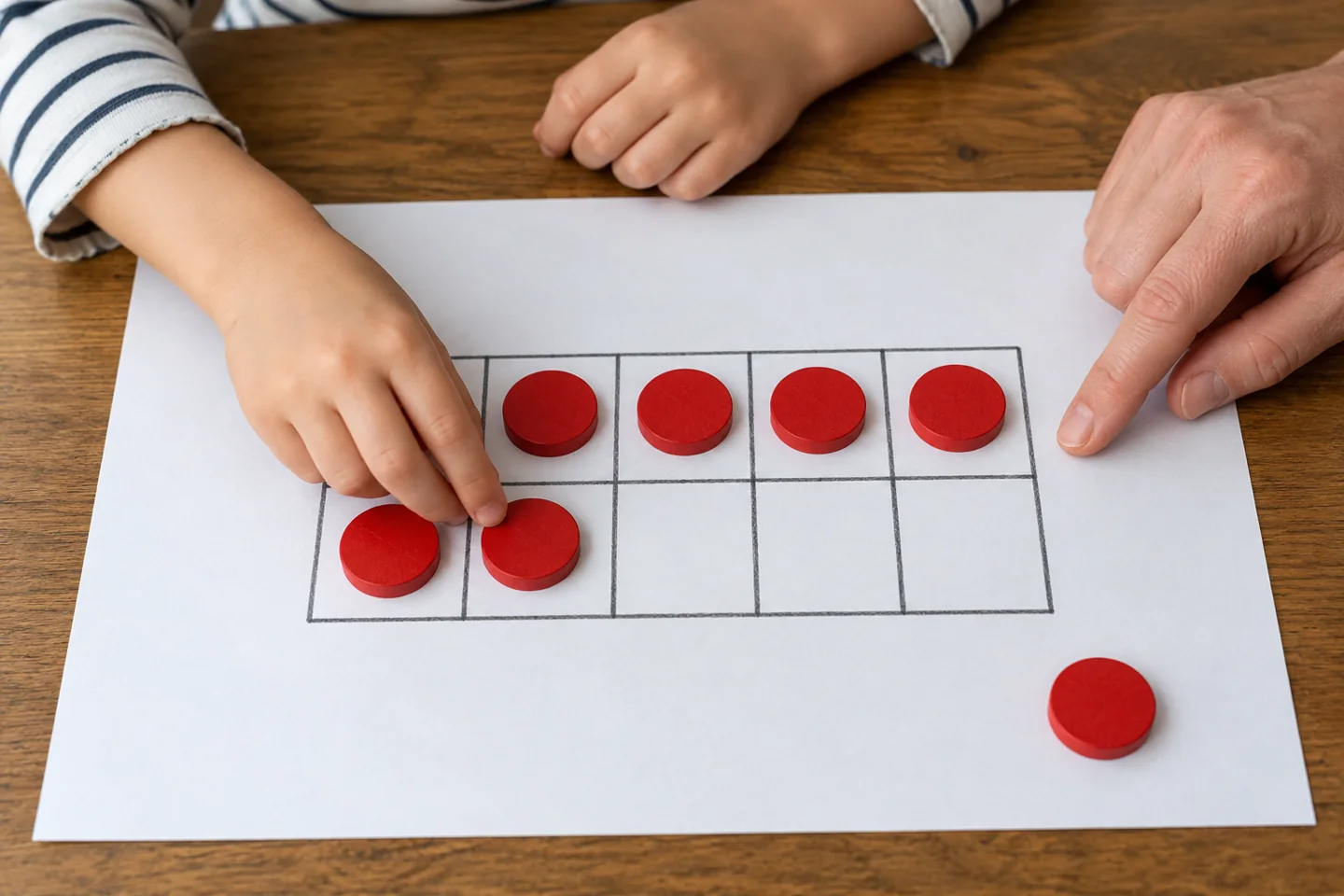
Put eight objects in one row and five in another. Before calculating, decide what the question asks you to find: the gap between the groups, or their combined amount.
Name the quantities and the unknown
Label the rows 8 and 5. If the question is “How many altogether?”, the unknown is the total when both groups are joined. If it is “How many more does the group of eight have?”, the unknown is the difference between the groups.
The words alone do not choose the operation. The quantities and the relationship in the question do. The Institute of Education Sciences recommends deliberate instruction with word problems and support for students to explain mathematical ideas clearly. [1]
Compare by matching
Line up one object from the group of five with five objects from the group of eight. Each matched pair accounts for one object in each group. Three objects in the row of eight have no match, so the difference is three.
This comparison can be represented as 8 − 5 = 3. Ask what the 3 counts: it is the unmatched amount, not the number of objects in either original group.
Combine by joining
For “How many altogether?”, bring the two rows together and count all the objects. There are thirteen in the combined set, represented by 8 + 5 = 13.
The same starting quantities now answer a different question. In the comparison, the learner looks at what separates the amounts. In the combination, the learner counts both amounts as one total. Keep the original groups visible while discussing the difference.
Use one bar, two relationships
Draw a bar divided into two parts labeled 5 and 3, with the full length labeled 8. This represents the comparison: the smaller amount and the gap make the larger amount. For the total question, draw two adjacent parts labeled 8 and 5 and label the full bar 13.
These diagrams use the same quantities but show different relationships. Ask the learner to point to the quantity each label names. A drawing is useful when its parts correspond to the situation, not just because it contains bars.
Check the unit and the question
Before writing an answer, repeat the question in the learner's own words. “How many more?” asks for the unmatched amount. “How many altogether?” asks for all items after joining. Then check that the answer is counted in the relevant unit, such as objects, points, or pages.
If an answer is three, ask whether that means the gap or the combined total. If it is thirteen, ask whether that includes both groups. This explanation reveals whether the relationship was understood, beyond whether the arithmetic was correct.
Finish by attaching each number to its meaning: the row of eight has three more objects than the row of five; both rows contain thirteen objects altogether. Reading those two sentences back helps keep the comparison separate from the combined count.
References
Sources for the cited guidance and reported material. Worked examples and practical tools are original to Zolls.
- Institute of Education Sciences. Assisting Students Struggling with Mathematics: Intervention in the Elementary Grades.